Duża dostępność
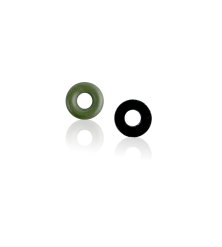
The 1mm thickness is not incidental - washer 40041 is a precision component whose dimension determines the correct axial alignment of the roller bearing in the pump drive assembly. The 60x85mm diameters correspond directly to the dimensions of cam bearing 40040, with which the washer cooperates in the same assembly.
The washer is installed in the Kranzle pump drive assembly, adjacent to the cam roller bearing. Its function is to precisely establish the axial position of the bearing - it provides the correct clearance between the bearing and the neighbouring drive components. The 60mm internal dimension corresponds to the journal on which the bearing operates; the 85mm external dimension defines the thrust surface. The 1mm thickness is a design value - smaller than that of cam washer 40039, which performs a different spacer function in the same area of the mechanism.
The dimensions 60x85x1mm must all match simultaneously - particularly the 1mm thickness, which is a precision value. Confusing this part with cam washer 40039, which measures 62x85x4.75mm, is a realistic purchasing error: both operate in the same assembly but have a different internal diameter and an entirely different thickness. The 2mm difference in internal diameter and the 3.75mm difference in thickness rule out any interchangeability. Reference number 40041 unambiguously identifies the correct variant - stick to this number when ordering.
Kranzle catalogue part. Used among others in Kranzle pressure washers with a pump featuring a cam drive system. Cooperates in the assembly with cam roller bearing 40040. Verify compatibility with a specific model using reference number 40041 or the pump service diagram.
[faq]
What is the difference between bearing washer 40041 and cam washer 40039, and can they be confused during installation?|These are two different components operating in the same assembly. Washer 40039 has dimensions of 62x85x4.75mm and performs a cam spacer function. Washer 40041 has dimensions of 60x85x1mm and is a precision element positioned at the bearing. The difference in internal diameter - 60 vs 62mm - physically prevents interchangeable seating of the two washers, but during careless assembly they can be placed in the wrong position. If in doubt, verify by reference number, not solely by external diameter.
Can the 1mm thick washer be replaced with a standard washer from a technical supplier measuring 60x85mm?|Only if the thickness is exactly 1mm and the washer is made from a material with adequate hardness and flatness. Standard washers from technical suppliers often have different thickness tolerances or inferior surface flatness. In a drive assembly operating under load, a thickness deviation translates directly into axial bearing play. The safer choice is the original catalogue part 40041.
Can the thin 1mm washer deform during tightening of the drive assembly?|With correct installation and even tightening - no. The risk of deformation arises when the housing is tightened unevenly or when installation is carried out at an angle, where the force is not distributed symmetrically across the entire washer surface. If axial play is present in the assembly after installation, it is worth checking whether the washer has bent during assembly.
How to identify that the washer, rather than the bearing, is the source of axial play?|After disassembling the unit, check the washer thickness at several points around the circumference - unevenness indicates localised wear. If the bearing is in good condition, the raceway is clean, and axial play only appears after the assembly is put together, the washer is the first component to verify. Axial play in the bearing itself can be felt during manual rotation - a worn bearing will have radial play or will crunch.
Is it always necessary to replace washer 40041 when replacing bearing 40040?|Not always, but it is worth checking its condition while the assembly is open. If the bearing has seized or operated with play for an extended period, the thrust surface of the washer may have worn unevenly. A washer in good condition - flat, free of pitting, and with uniform thickness - can remain in place. Replacing both components simultaneously makes sense as a preventive measure during a thorough service of the drive assembly.
[/faq]
Model
Therm 870-1
Model
Therm 1017 T
Model
Profi-Jet B 16/220 T
Model
Therm 890
Model
Therm 1017
Model
Profi-Jet B 20/200
Model
Therm 1160
Model
Profi-Jet B 16/250 T
Model
Profi-Jet B 20/200 T
Model
Profi-Jet B 230 T
Model
Therm C 11/130
Model
Profi-Jet B 16/250
Model
Profi-Jet B 240 T
Model
Therm C 13/180
Model
Therm 895
Model
Profi-Jet B 270 T
Model
Therm C 15/150
Model
Therm 1165
Model
Therm 601 E-ST 18
Model
Therm C 15/150 T
Model
Therm 602 E-M 18
Model
Therm 601 E-ST 24
Model
Therm CA 11/130
Model
Therm 602 E-M 24
Model
Therm 871 E-ST 48
Model
Therm CA 11/130 T
Model
Therm 602 E-M 36
Model
Therm 601 E-ST 36
Model
Therm CA 12/150
Model
Therm 872 E-M 48
Model
Therm 891 E-ST 48
Model
Therm CA 12/150 T
Model
Therm 635-1
Model
Therm CA 15/120
Model
E-Therm 603 M 36
Model
Therm 875-1
Model
Therm C 13/180 T
Model
D 26/250 TST
Model
E-Therm 603 M 36 T
Model
W 11/135
Model
W 13/230
Model
Quadro 799 TST
Model
D 30/180 TST
Model
E-Therm 873 M 48
Model
W 15/200
Model
Quadro 899 TST
Model
E-Therm 873 M 48 T
Model
W 19/160
Model
Therm C 11/130 T
Model
Profi-Jet B 16/220