

 Ostatnie sztuki!
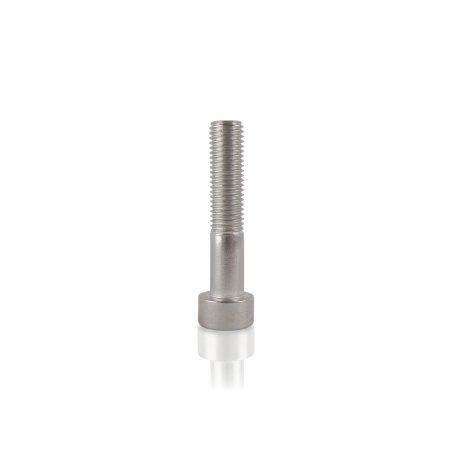
Screw 410172 is a socket head cap screw M8x55 made of A2 stainless steel to DIN 912. The cylindrical head with hexagon socket allows installation in locations with restricted access, where an open-end or socket wrench cannot complete a full rotation. Material A2 (acid-resistant stainless steel, equivalent to AISI 304) provides corrosion resistance – important under constant contact with working water, moisture and detergents used in pressure washers.
The screw is used when assembling structural components of Kranzle pressure washers, in locations exposed to moisture or direct water contact, where ordinary carbon steel would corrode significantly faster. The 55mm length and M8 thread indicate a connection carrying moderate loads – typical for housing, cover or mounting fasteners, not for the main structural connections of the pump or motor. Verify the exact installation point from the disassembled machine.
Three parameters must match simultaneously: thread M8, length 55mm and material A2 (stainless steel). The length of a DIN 912 screw is measured from the underside of the head to the end of the shank – it does not include the head. Before ordering, measure the shank length of the removed screw with a calliper, not the total length including the head.
Material A2 is not a parameter that can be freely substituted with ordinary galvanised carbon steel – at points with constant water contact, ordinary steel corrodes significantly faster, which for hard-to-reach parts leads to galling of the screw on any future removal attempt. If the original is A2 steel, keep this material when replacing.
Identify by reference number 410172 – for standard screws, the Kranzle catalogue number is a more reliable basis for selection than independently finding an equivalent in a standards catalogue, as the manufacturer may have applied additional requirements regarding material or tolerances.
Fastener for Kranzle pressure washers. Verify the range of application by reference number 410172 and dimensions M8x55 DIN 912 A2.
Why is this screw made of A2 stainless steel and not ordinary galvanised steel like many other connections in the washer?|A2 steel is used at points with direct or frequent contact with water and moisture – under such conditions ordinary carbon steel, even galvanised, corrodes significantly faster, particularly once the zinc coating is damaged. An A2 screw in this position prevents galling of the connection during future disassembly and leaves no rust marks on visible housing components. If you are replacing this screw, retain A2 material – substituting ordinary galvanised steel will shorten the connection's service life in a humid environment.
Can an A2 M8x55 screw be replaced with an A4 screw if A2 is not available at the moment?|A4 steel (equivalent to AISI 316) has higher corrosion resistance than A2, particularly in chloride-containing or heavily salted environments – under pressure washer conditions the practical difference between A2 and A4 is usually small. Geometrically both screws are identical and interchangeable. If A2 is unavailable, A4 with the same M8x55 DIN 912 dimensions is a safe substitute.
How to correctly measure the length of a screw if I need to confirm it is 55mm and not another size from the same family?|The length of a DIN 912 screw is the distance from the flat underside of the head to the end of the shank – measured without the head. Place a calliper against the underside of the head and measure to the tip of the thread. The cylindrical head of an M8 socket head cap screw has a standard height of 8mm to DIN 912 – if you measure the total length of the screw including the head and get approximately 63mm, the shank is 55mm and the screw is correct.
Do A2 stainless steel screws require a different tightening torque than carbon steel screws of the same dimensional class?|A2 stainless steel has lower tensile strength than class 8.8 carbon steel at the same diameter – typical tightening torques for A2 screws are lower than for an equivalent class 8.8 screw. In addition, stainless steel is more prone to thread galling (cold welding) when assembled dry – using assembly grease for stainless threads is recommended, as it reduces the risk of galling and allows for more predictable tightening. If you do not have a torque specification for this specific connection, tighten moderately, without the excessive force typical of higher strength class screws.
How to tell whether the hexagon socket in the head is damaged enough that attempting to remove the screw with a key is not worth trying?|If the hex key enters loosely or you feel that the rounded socket does not grip at low torque – do not force it. With stainless steel screws the risk of thread galling when attempting removal with a slipping key is higher than with carbon steel. In such cases use a screw extractor or a drill to cut off the head. As a precaution: always use a hex key with a full profile and in good condition, and when fitting A2 screws use grease for stainless threads to make future removal easier.
[/faq]
Model
E-Therm 500 M 18 T
Model
E-Therm 500 M 24
Model
E-Therm 500 M 24 T
Model
Profi-Jet B 10/200
Model
Profi-Jet B 10/200 T
Model
2160 TST
Model
Therm 715
Model
2175 TST
Model
Quadro 12/150 TST
Model
2175 TS
Model
HD 9/80
Model
2195 TS
Model
HD 12/130
Model
2195 TST
Model
Quadro 9/170 TST
Model
HD 9/80 TS
Model
HD 12/130 TS
Model
Quadro 11/140 TST
Model
2160 TS
Model
E-Therm 500 M 18
Connector
M8x55