

 Mała ilość
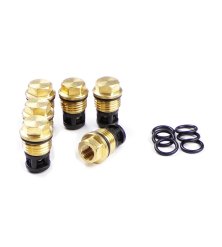
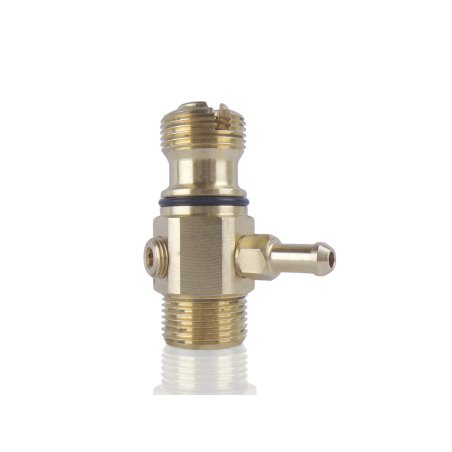
Connector 405222 is the outlet component of the Kranzle AQ series pressure washer pump with a built-in check valve and detergent injector channel. On the pump side it screws in with an external ¼" thread into the valve block; on the hose side it has an external M22x1.5 thread – both threads are male. The set contains 9 components:
check valve mechanism:
and injector components:
The injector version – unlike connector 405221 (without injector) – allows the pump to draw in detergent without additional external accessories.
The connector is mounted in the outlet bore of the AQ pump valve block. The external ¼" thread screws into the pump; the external M22x1.5 thread requires a hose end with an internal M22x1.5 thread. The built-in ball check valve operates on the same principle as the valves in the valve block – the ball prevents water from flowing back from the hose into the pump on shutdown.
The injector channel with suction connector 13234 (NW6, ball joint) allows a tube to be connected to a detergent tank. When water flows through the connector, negative pressure is created in the suction channel, drawing in detergent and mixing it with the working water. When the injector is not in use, the suction channel bores are closed with plugs 13385 and O-rings 13386 – preventing air from being drawn into the circuit. The ball joint of connector 13234 allows the suction tube to be angled in different directions without additional elbows.
Identify by reference number 405222 and AQ pump type. The key difference from connector 405221 – the version without injector – is the presence of a suction channel with an M10x1 seat for the plugs. During disassembly, check whether the existing connector has a side bore with M10x1 thread and a suction tube or plug in that bore – this unambiguously confirms the injector version.
If the problem concerns only the built-in check valve with the connector body intact – the mechanism components (12122, 141201, 40016) may be available separately. If the problem lies in the suction connector, replacing component 13234 alone is possible. Plugs 13385 and O-rings 13386 are the least expensive components in the set – it is worth replacing them as a precaution at every connector service.
Outlet component for Kranzle AQ series pressure washer pumps. Pump thread: ¼" external (male). Hose connection thread: M22x1.5 external (male) – requires a hose end with internal M22x1.5 thread. Injector version – not a substitute for connector 405221 (without injector). Contains: ball 10mm (12122), spring (141201), O-ring 18x2 (40016), NW6 suction connector with ball joint (13234), 2x plug M10x1 (13385), 2x O-ring 6x1.5 (13386). Verify the exact compatibility range by reference number 405222.
How does the injector in connector 405222 work, and when is detergent drawn in and when is it not?|The injector operates on the Venturi effect – water flow through the narrowed connector channel creates negative pressure in the side suction channel, which draws detergent from a connected tank. Drawing occurs only with the gun open and water flowing – with the gun closed and the pump running in bypass, flow through the connector stops and no negative pressure is generated. The amount of detergent drawn in depends on working pressure and channel geometry – it is not adjustable by the connector itself.
What are plugs 13385 with O-rings 13386 for, and when should they be used?|Plugs 13385 close the injector suction channel bores when the detergent tube is not connected. Without plugs, the open bores draw air into the water circuit with each pump stroke – resulting in pressure pulsation and foaming in the hose even without detergent. When replacing the connector or servicing the injector, always check the condition of O-rings 13386 at the plugs – worn O-rings allow air through despite the plugs being fitted and produce identical symptoms to missing plugs.
How to diagnose why the injector is not drawing in detergent – where to start?|Start with the simplest check: confirm the suction tube is submerged in detergent and is not blocked. Then make sure plugs 13385 have been removed from the suction channel bores – it occasionally happens that one plug remains in the second bore and blocks the flow. If the tube and bores are clear, check suction connector 13234 – its spring presses against the seal and may be blocked by deposits. The final step is checking the Venturi channel in the connector body for blockage – limescale from hard water gradually narrows the channel and reduces suction. Descaling the connector in a citric acid solution often restores function without replacing the component.
[/faq]
Model
2175 TS
Model
2195 TS
Model
HD 9/80 TS
Model
HD 12/130 TS
Model
1152 TS
Model
HD 9/80
Model
HD 12/130